Drivers Test and Road tips
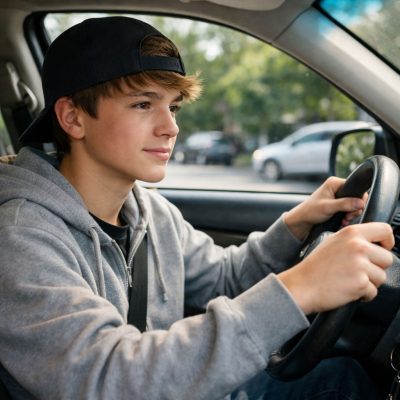
Practice what to do when you first get in the car to take your test:
Lock your doors, put your key in the ignition, fix your seat, fix your steering wheel, fix all three mirrors, and your seatbelts -check DMV agent seat belt.
Then
PARKING BRAKE, signal light, three point check.
Some tips for confidence:
Put the center line in the bottom left hand corner where the windshield meets the dash board. This will keep you centered in the road.
Making a right turn:
When your sideview mirror gets to the end of the curb, turn your wheels all the way to the right.
And then of course, straighten out.
This will ensure that you don’t hit the curb and you don’t go over the white line.
Always practice on the back roads first and go slower until you get your confidence up.
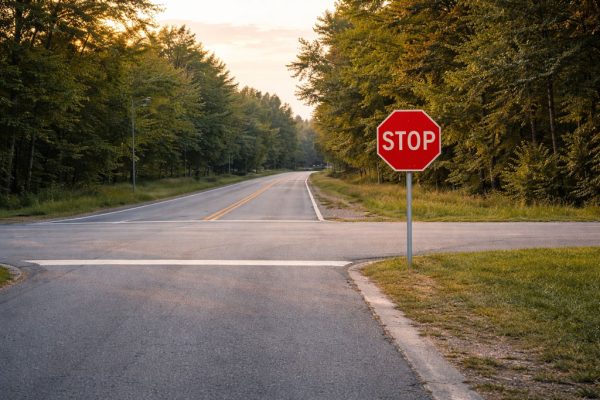
At a stop sign you must come to a complete stop behind the white line for three seconds and look left, right, left.
(Let’s combine that to one second left, one second right, one second left).
Stay behind the white line at stop signs (one second left- one second right -one second left)
If you need to roll up (don’t go past the curb), roll up to where you can see and then go to 0 (complete stop) and do your one second left one second right, one second left again.
If all sides, have a stop sign and you get there first, then do your one second left, one second right, one second left and take your right of way.
If all sides have a stop sign and you get there at the same time, the person to the right has the right of way.
Also stay behind a white line at a red light.
You don’t need to roll up because the light will turn green and you then have the right of way.
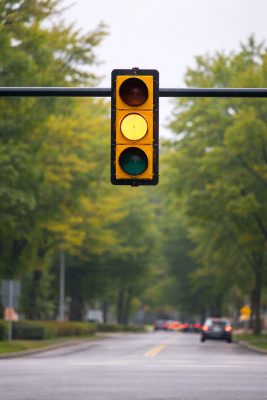
Don’t get caught in a yellow!
Always slow to the lights.
If the speed limit is 30, then slow to 25, 24, 23 if the light ahead is green and then gradually get back up to speed as you go under the light.
If the light ahead is red or yellow, gradually slow to a stop.
Yellow means stop unless you are underneath it.
Left through the light:
If the light is green and you have No oncoming traffic (don’t forget to signal left 3 seconds before you reach intersection) clear the intersection (in other words just go).
However if there is oncoming traffic:
Oncoming traffic has the right of way – stop behind the white line until there’s no oncoming traffic (going over the white line is a fail) when it’s safe and no oncoming traffic then you must clear the intersection at the regular speed – and you will subsequently have to signal right -do your three-point check to the right and get into the right lane- because left lane is passing and left turn lane, and right lane is the travel lane.
+++ Always signal 3 seconds before you are going to turn +++
————The above parking video is great for reverse to the left and will help with easy reverse to the right breakdown below————
Reverse parking to the right:
(like the reverse to the left except the CAR is in the center of the aisle).
1) Put your right signal on.
2) Put your car in the center of the aisle.
3) Put your shoulders in the second space past your space.
(your side view mirror should be parallel to the second line of the second space past your space).
4) Put your car in reverse (gear before steer).
5) Keep your foot on the brake and turn your wheel all the way to the right.
6) Do a full scan – right side mirror – rear view mirror – left side mirror – over your left shoulder and do a proper backing posture.
7) Go back until parallel to the lines in the space – stop.
8)Straighten out your wheel (1 1/2 turns).
9) Resume backing posture and keep wheel straight while backing up until shoulders are in the center of the space.
(When your car is parallel to the lines you only have to go straight back).
10) Check the front of the car to see that you are in the space.
11) Park, park!
+++ If parking lot is not regular size begin parking maneuver 4 to 5 feet from spaces +++
Here is a breakdown of
Parallel Parking:
Put your right signal on.
Line up the back of your vehicle with the back of theirs (if your car is the same size side view mirrors should line up).
Shift to reverse, put your foot on brake and turn your tires all the way to the right.
Check oncoming traffic, rear view mirror, side view mirror, and over your left shoulder.
If traffic is clear go back (keeping wheel all the way to the right) until your shoulders are parallel with the back light of his/her vehicle and stop (you can also go by when your body lines up with the back of the vehicle) and stop.
Straighten out the tires and retake your backing posture.
Back up straight until your side view mirror covers the license plate and stop (if license plate is in center of car, if not go by when your front end passes the other vehicle and stop).
Turn your tires all the way left and re-take your backing posture and go in.
Stop when you are parallel to the car in front of you.
Straighten out your tires.
Park, park!
S- correction:
You get three tries for back in maneuvers in most states.
(Of course it’s best to get it on the first try -but if you can’t then you can do 2 S-corrections).
If you go too far to the right:
When you back in and realize u are too far to the right you’re going to put your car in drive and drive your car up so that the Sideview mirror is above the top of the line of your space.
It’ll be only driving up a few feet.
Then you say in your head- “I went too far to the right so I am going to turn my steering wheel all the way to the left.”
(Keep your foot on the brake and turn the wheel all the way to the left).
If it’s 3 feet off, go up four feet to the left.
(I would always add one foot).
You will then stop, keep your car in drive and turn your wheels all the way to the right.
(Keep your foot on the brake as u do this), then go right till your car is parallel to the lines in your space.
Put your car in reverse (gear before steer) and STRAIGHTEN out your steering wheel.
Put your left hand on twelve o’clock, your right hand behind the passenger seat headrest and your face looking straight out the back window
(proper backing posture).
Go back until curb disappears from side mirror (or white line that goes straight across in back of car).
Park, Park.
If you go to far too the left you say to yourself “I went to far to the left so I am turning my wheels all the way to the right”.
(If it is two feet go three feet), go right to offset and stop, keep in drive and turn your steering wheel all the way to the left.
(Keep your foot on the brake until wheel is all the way to the left) and then go left until the car is parallel to the lines in your space).
Put your car in reverse (gear before steer) and STRAIGHTEN out your steering wheel.
Put your left hand on twelve o’clock, your right hand behind the passenger seat headrest and your face looking straight out the back window
(proper backing posture).
Go back until curb disappears from side mirror (or white line that goes straight across in back of car).
Park, Park.
+++ when you get this down it can be a fun little twist (so to speak)
it’s just a repositioning to the left and then right or vice versa— hence S correction +++
Reflexive Exercise:
Get as many to participate with you as you can- sisters, brothers, friends, mom and dad.
First you will get in the car (no keys), fix your mirrors,seat and seat belt.
Everyone will get around the car in different areas (make sure that some are like 3, four feet away- the length of a car in another lane).
You will then do a three point check to the left (rear view mirror, left side view mirror and over your left shoulder) calling out those on the left.
ie.” Sarah I see you in my blind spot”- “Dad I see you at the back of the car”.
Then do a three point check to the right, (rear view mirror, right side view mirror and over your right shoulder) – “Mike I see you on my right side”, etc.
You can make it go faster. (Like musical chairs meets hide and go seek).
Put your own spin on it.
If you could see Sarah in your blind spot, you can see a car in your blind spot. If you can see your dad in the back of your car, you can see a car in the back of your car.
It will help you develop your reflexes and know where everything is in proportion to where you are sitting.
And will help you do faster checks when you change lanes.
Final notes
A) Do not put your car in park until you’re sure that you are finished with your maneuver – ie. Check right side mirror for line in case you need to do S correction and check front of car to make sure you are in the lines.
B) Do not perform 3 pt. turns in front of driveways or intersections.
C) If you’re straightening the car by getting the doorhandles parallel to something in your side view mirror and you overshoot it so you are crooked-
Do Not Move Steering Wheel.
Stop the car, change gears, and stop again when the vehicles position is corrected and change gears again if necessary to continue the maneuver.
For example if you’re backing up until parallel and back up too far -stop, put in drive and go fwd a little till parallel-leaving steering wheel the way it is.
You will then (when parallel with line) put into reverse and straighten out your wheel 1 1/2 turns -backing posture and go back till curb disappears from bottom of the mirror – check your front – if you are in the space – park park.
If not just go back so your shoulders are in the center of the space and you aren’t sticking out – you don’t want to hit the curb or line and u don’t want to stick out in the front-
D) If alarms or chimes go off find a safe place to pull over or park and check your instrument panel for warning indicator lights.
And
If an emergency vehicle pulls up behind you —you are going to immediately slow down and pull over to the right —— if you can’t – stay where u are.
E) If you have the right of way do not intentionally wave on other cars to yield the right away to them. The agent will think you do not know when you have the right of way.
F) Always turn your signal in the direction that you’re going to turn your wheel (the only time this is not the case is when you are swooping over for right pull ins or are doing parallel parking – in this case always signal in the direction of the curb).
G) Assume the agent wants you to continue driving straight unless he or she provides you with directions.
H) When fastening your own safety belt check the DMV examiner seatbelt and make sure it’s fastened as well – ask him or her nicely to fasten safety belt before u shift into drive. (After you fixed all 3 mirrors).
I) Your following distance should be a minimum of three seconds in ideal conditions— for poor weather conditions or if you’re following a truck or a motorcycle the legal minimum following distance is four seconds but the DMV recommends 5 to 6.
+++ You may be asking – How do I know how to stay 3 seconds behind the car in front of me?—
Pick a reference point ahead and as soon as the car in front of you passes it, start counting.
If you get there before you count to three, you are going too fast.+++
J) You signal much more in parking lots than you do on the road – and don’t forget unless there is a speed limit sign on a track
ie. 10 mph —parking lot speed limit is 5.
Good Luck on your test!
You got this!